Systems · Capital
The disciplined investing engine
A rules-based long-term practice — sizing over picking, sell discipline over buy thesis, decisions graded separately from outcomes.
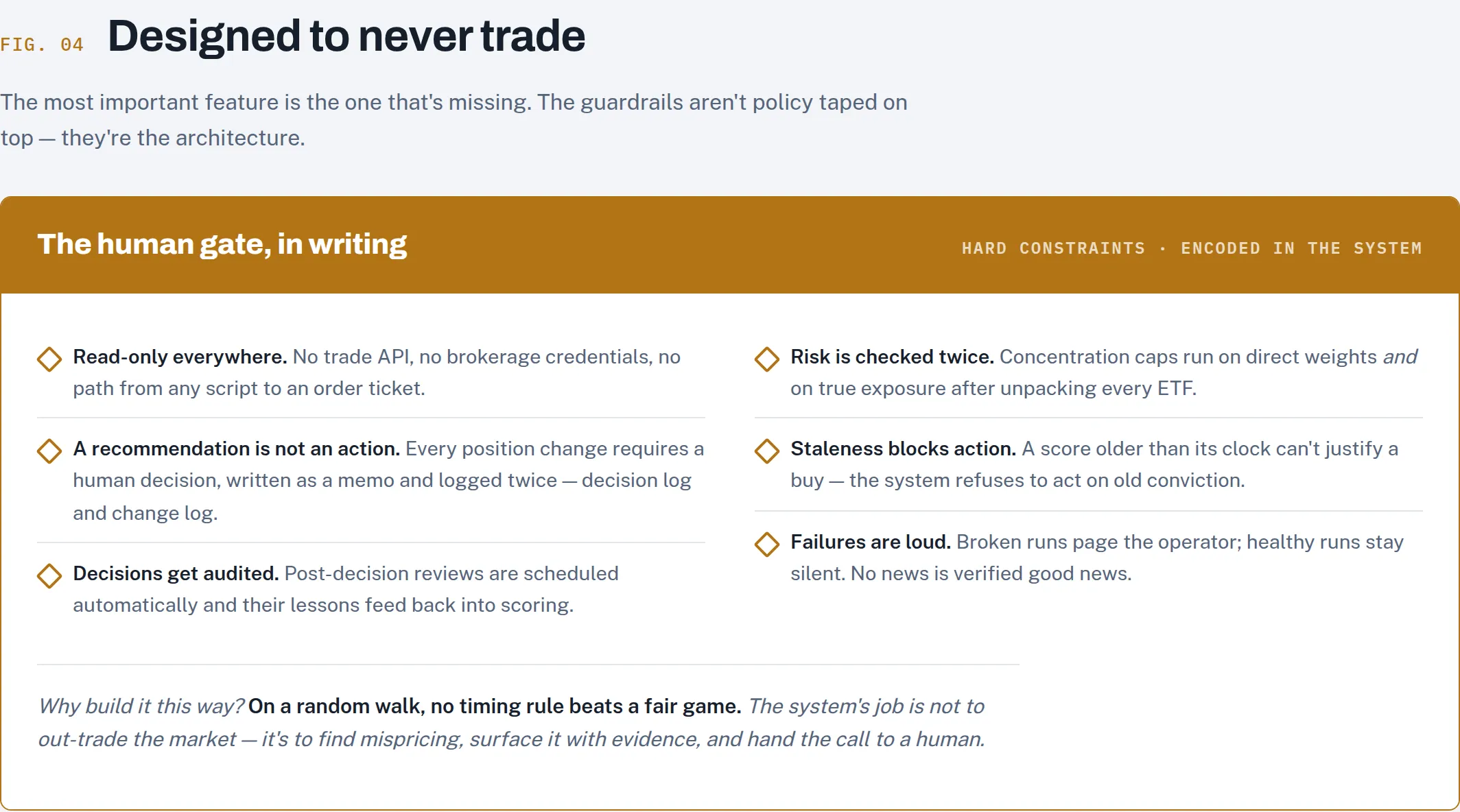
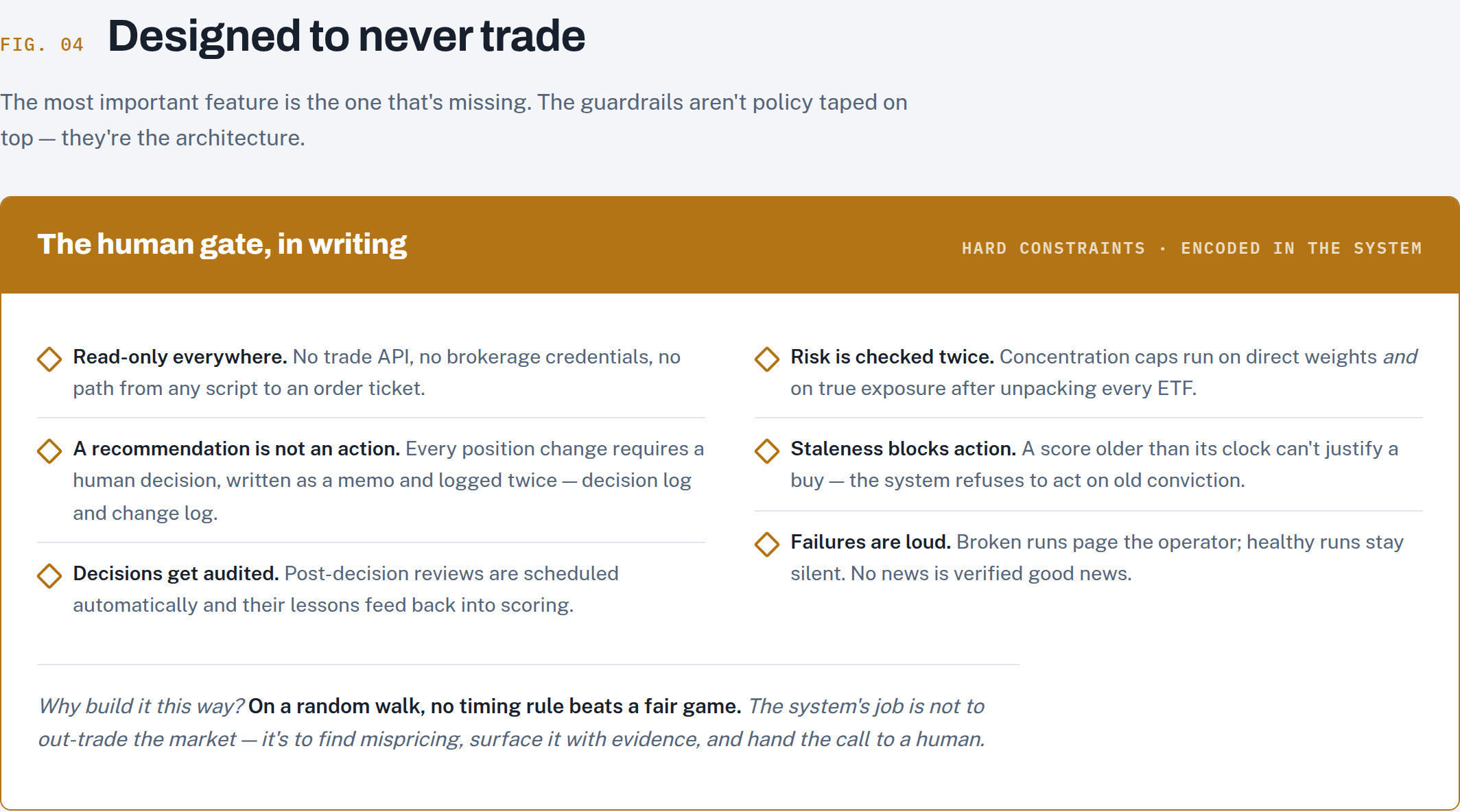
The most important feature is the one that's missing
The system reads everything and can do nothing. No trade API, no brokerage credentials, no path from any script to an order ticket — not disabled, not configured off, simply never built. A recommendation is not an action here, and the only route from one to the other runs through a written memo and a human who has to sign it.
That is the whole design, and it is worth being clear about why. An investing system that can act is a system whose worst day is unbounded. One that can only argue has a worst day of being ignored. I would rather be occasionally slow than once catastrophically fast, and the way you guarantee that is architecture rather than intention — guardrails aren't policy taped on top; they're the building.
Three rules
The whole system hangs on three rules, written down before any money moves:
- Sizing beats picking. A great pick at one percent of a portfolio doesn't move the needle; a mediocre pick oversized can blow you up. Conviction has to map to position size — deterministically, not by mood.
- Sell discipline beats buy thesis. Every position gets its exit triggers defined at entry — at least one of them a "my thesis was wrong" trigger. Triggers are written when you're calm and honored when you're not. They are never negotiated in the moment.
- Grade decisions, not outcomes. Every decision gets reviewed ninety days later — process and outcome scored separately. The dangerous square isn't a loss from a good process; it's a win from a bad one, because that's the one that teaches you the wrong lesson.
Why rules at all
First principles: over short horizons, prices behave close enough to a random walk that no timing rule adds expected edge — that's not a vibe, it's theorem-grade math. If edge exists at all, it comes from understanding a business better than its price does, and from the discipline to act on that understanding slowly. So the system weighs fundamentals overwhelmingly over technical signals, holds for years, and treats "do nothing" as the default action.
What runs while I'm not looking
Discipline that depends on me being at the desk is not discipline, it is a mood. So the arithmetic happens on a schedule whether I show up or not: one run every weekday afternoon, under a wake lock so a sleeping laptop cannot quietly skip a day and leave me looking at numbers I believe are current.
It recomputes performance and risk the way an institution would — money-weighted returns rather than the flattering kind, exposure checked after unpacking every fund rather than on the labels — and then rebuilds every surface I actually read from that. Eleven steps, each with its own timeout, each able to fail loudly. A healthy run leaves nothing behind but fresh state. That silence is the point: a notification you get daily is a notification you stop reading.
An engine scores businesses on a hundred-point scale across eight weighted components — financial strength, moat, growth quality, profitability, capital allocation, balance-sheet risk, valuation, and a small technical-context factor. Hard gates keep it honest: no strong rating survives a weak valuation or a weak balance sheet, and sentiment is never an input. A score older than its own clock cannot justify a purchase, which is the system refusing to act on stale conviction — including mine.
But scores never trade. Scores feed memos — a written thesis with the counterargument, the "what would make me wrong," a bias check, and a human decision at the bottom. The system prepares; I decide. It has read-only access to everything and execution authority over nothing.
Equally deliberate is what it refuses to do: no price prediction, no sentiment scoring, no automated execution, no collapsing a business into one magic number.
What I'm actually thinking about
The framework is the durable half; the theses are the half that changes. These are the sector questions I've been sitting with — written down so that when I'm wrong I can tell, which is the only reason to write a thesis down at all.
- Infrastructure that already exists beats infrastructure that's announced. I spent years running physical operations, and the gap between a funded plan and a working system is measured in years and lawsuits. I'm more interested in businesses maintaining something that already carries load than in ones promising to build it.
- The boring layer under a boom is usually mispriced. Not the thing everyone is naming — the thing it can't run without. Power, cooling, permits, right-of-way, skilled trades. Unglamorous, hard to replicate, and the constraint nobody models until it binds.
- Regulated businesses are misread in both directions. Regulation is treated as a pure drag, but it's also a moat, a pricing floor, and a reason competitors can't simply show up. Having sat on the compliance side of a contract, I think the market systematically underrates how much of a business the paperwork is.
- Food and water are infrastructure that hasn't been treated as such. The thesis behind the company I'm building, applied at a scale I don't operate at. Local, resilient, unsexy, and structurally short on capital.
No positions here, now or ever. If one of these is right it'll show up in a memo I wrote before it was obvious, which is the only proof that counts.
This page describes a personal practice. It is not investment advice — I'm not a licensed anything, and my rules are calibrated to my life, not yours.