Works in progress
Not finished yet
Five things I am in the middle of. A portfolio of only finished work is a portfolio that is lying by omission, so these get a page too — with an honest account of what is done and what isn't.
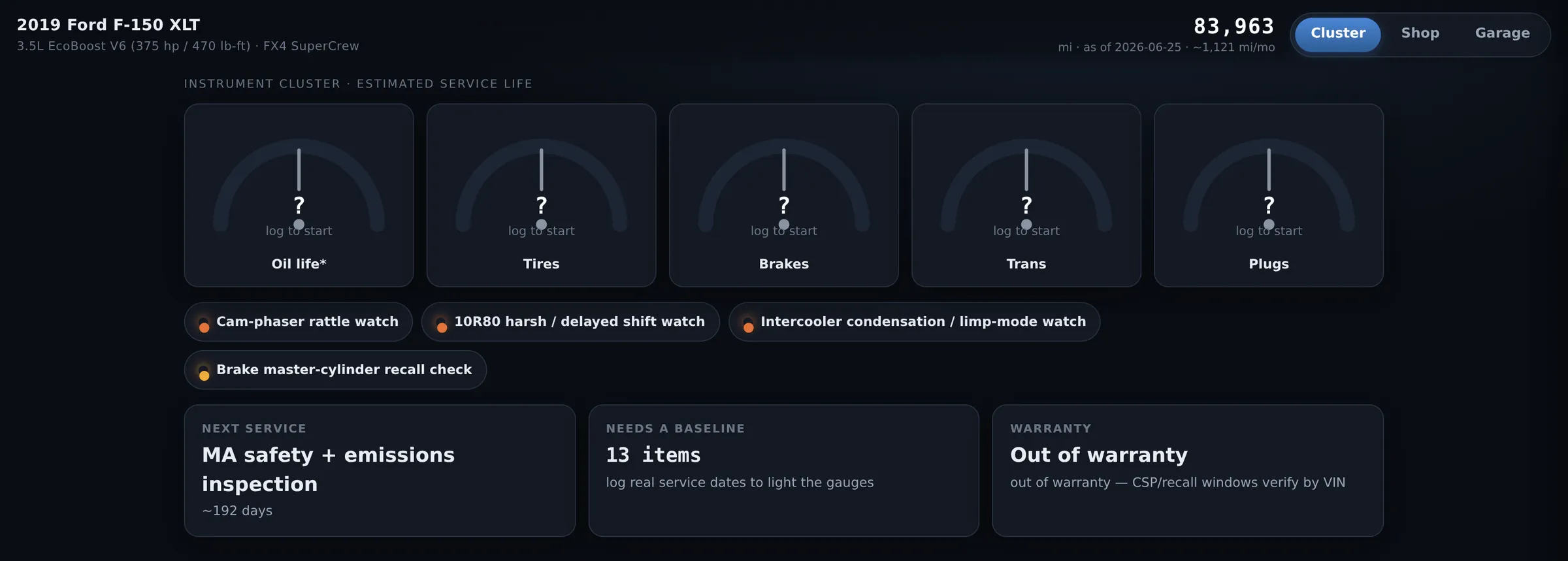
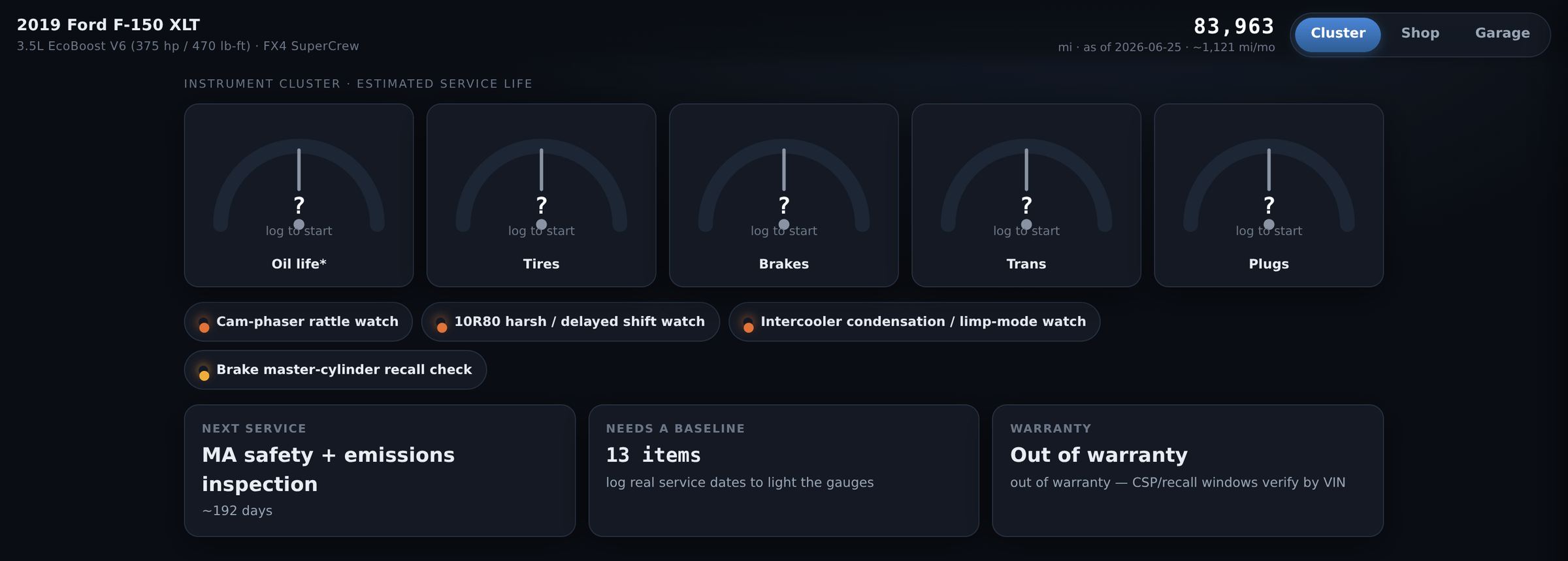
My ‘Built Ford Tough’ F-150
A 2019 F-150, run on the same discipline as the tractor: a maintenance log that is actually current, a watch-list of the known issues for its engine and transmission generation tracked against the real service bulletins, and a short, deliberate upgrade path rather than a parts habit.
It has the same cockpit — the same 3D view, the same computed service status, the same refusal to claim a date it can't source — because the second time you build something like this, it takes an afternoon instead of a month. That is the actual finding here, and it is worth more than the truck page: the pattern was the product. I did not know that until I pointed it at a second machine.
Done: the log, the equipment cards, the cockpit, OBD logging through a real scan tool rather than a phone dongle guessing. Not done: the watch-list is still partly in my head, and the upgrade path has opinions in it I haven't finished arguing with.
MowLines
A mobile app for planning mowing patterns on a real piece of ground — stripes, turns, the order you cut so you aren't driving over what you just laid down. It came out of the ordinary irritation of doing it badly by eye and then living with the result for a week.
It works well enough to argue with, which is further than most weekend projects get. It has not passed the only test that counts.
That test is: mow my own lawn with it. Until I have, anything I tell you about whether it works is a guess about my own software, and I have been on the receiving end of enough of those to know what they're worth. It is also seasonal in a way that is genuinely inconvenient — the window closes, and a mowing app has nothing to say to anybody in January.
My House Studio
A full set of architectural blueprints for our house — four sheets at true quarter-inch scale, regenerated from a single structured model rather than drawn by hand — plus an interactive 3D version of the same model.
The first real use case is on deck: sketching a west addition properly before any architect gets paid to do it. Not to replace the architect. To arrive at that conversation knowing what I actually want, which is the difference between a design fee and a design education.
It stays off GitHub permanently. The model is the floor plan of the house my family sleeps in, and there is no version of publishing that which I am comfortable with.
GroundSight
The map underneath the hunting system. Every feature I have ever marked in the field — stands, cameras, bedding, sign, access, hundreds of walked tracks — drawn on real elevation, with the scent screen and the validation queue laid over it. Pick a sit window and it fetches the forecast, rotates the scent cones hour by hour, and turns into a printed sheet for the truck and a route file for the phone.
It works, and I use it. It is being rebuilt anyway, for two reasons. The terrain it renders today is ten-metre survey data, which shows a ridge and hides everything that decides a stand — the bench, the saddle, the stone wall, the little drainage that pulls thermals downhill at first light. One-metre lidar turns out to exist for every area I hunt, and at that resolution those things resolve. The second reason is the interface, which grew a panel every time I had an idea. The rebuild drops the ground to a dark substrate and lets colour carry only one thing: state.
Done: the ingest pipeline, the scent screen, the sit planner, the field capture, the pattern mining, and a verified lidar source for every area. Not done: the rebuild itself. The design is locked; the code is not written. And like the house, it stays on one laptop — its data carries my neighbours' names and a pin on my roof, and there is no hosting arrangement that makes that acceptable.
The Fantasy Dynasty Engine
A model of a fantasy football league that never resets. In a dynasty league you keep your roster from one year to the next, so every decision is a multi-year decision — a draft pick is a claim on a player who does not exist yet, and a trade for this season's points is usually a loan against next season's. The simulator plays the seasons forward and puts a value on rosters and picks over that longer clock, then grades a trade before I make it rather than after.
Built in August, in the gap between seasons, which is the only time a thing like this gets built. It ran in the September draft. That is a first use, not a result: a model that has only ever been tested against the past has a specific failure mode I know well from other work, which is that it is very confident right up until it isn't.
Done: the league's rules encoded, the season engine, the valuation, the trade grader, and one live draft. Not done: the only test that counts, which is a season of those picks playing out. If it earns its keep it gets a page. If it does not, it gets a paragraph here explaining exactly where it was wrong — because I am the one who built it and, unlike the truck, I cannot blame the previous owner.